
As a genre, civilization games always draw from a couple of really big influences. The first is the original Civilization game, designed by Francis Treshem and published by Avalon Hill in the early 1980s. That game takes a lot of DNA from Avalon Hill’s Diplomacy, with its map full of different empires that interact with each other through warfare and trading. Another major influence is that of Risk, one of the most influential designs of all time, full stop. Any time you play a game with army men and dice, you are probably, on some level, playing Risk. The last big touchstone is that of Sid Meier’s Civilization, with its emphasis on the full sweep of history, the creation of great wonders, and the combination of short term and long term goals that make that game so addictive. On one level or another most civ games are recombining these different elements in various ways. It’s hard to break out of the legacy of a single major design, let alone three of them.
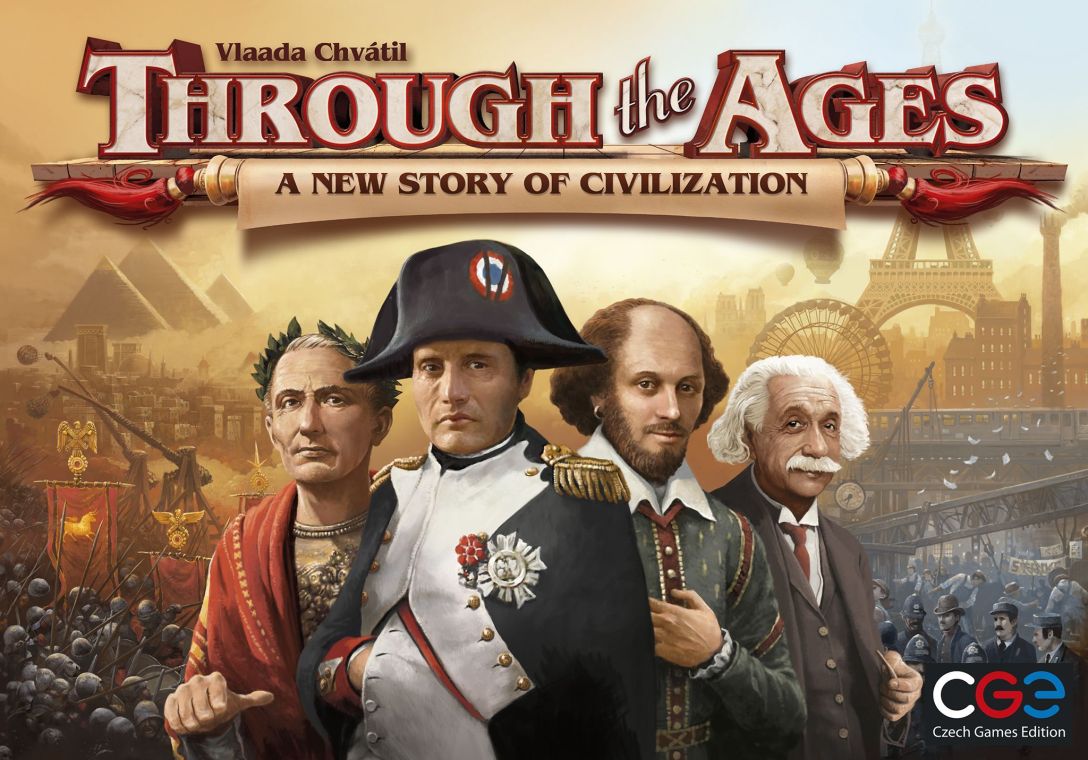
Through the Ages: A New Story of Civilization manages to stand out above the crowd. Originally published as Through the Ages in 2006, it represents perhaps the best complex design by Vlaada Chvatil, as well as his first real notable work as a designer. After a revised edition in 2015, it has come into its own as perhaps the most important civilization board game today. What’s striking about it is what it chooses to abstract, what it chooses to emphasize, and what it chooses to avoid. It’s a complex card game that is at once cumbersome and streamlined, violent and passive, infuriating and compelling.
What stands out to me the most about the game is its victory condition. In purely mechanical terms it boils down to victory points, but in game terms those points represent culture. You will get them in several ways, but the bulk of them will be generated by building structures like theaters and religious buildings, and by creating wonders like the Pyramids. I like this emphasis a lot, because thematically it’s hard to define what victory is in a civ game. How do we determine what civilizations have “won” in our own history? The ones who made the most money? The ones who conquered the most territory? Who knows? In Through the Ages, culture seems to represent that abstract quality of being remembered, regardless of how that legacy came about. Maybe your civilization made all sorts of amazing monuments. Maybe they created great works or founded an important faith. Maybe they used their military might to push their neighbors around. All of those ways ensure the memory of a civilization will live on. In its raw mechanics it’s just about finding different ways to generate victory points, but this focus on legacy says a lot about what we consider “great” in a civilization.Compared to something like, say, the multiple victory conditions in Sid Meier’s Civilization, Chvatil is doing something similar. The difference is that rather than giving us several different sub-systems that flow into different goals, we have a bunch of ways to get to a single goal. The only important thing is to be remembered, regardless of how you do it.
Most people who see Through the Ages for the first time will notice that it has no map. This is a pure card game, with any boards only serving as ways to make card play easier. It’s a design decision that almost seems a little flashy, like someone who’s right-handed using their left hand. But I think there’s a thematic purpose here too. Civilization games very often become displays of military might, with armies sweeping across continents and territories changing hands every couple of turns. This is not necessarily a bad thing, and games like Clash of Cultures have made hay out of being primarily games of conquest.
But here’s the thing about warfare: it’s expensive. It takes an enormous amount of resources to move people across the land so they can effectively kill other people. A lot of games seem to treat it as the default mode for countries. Every technology feeds back into it, and the design rewards warmongering above all else. It’s not a serious trade-off to commit to the military, and for a lot of people it’s just more fun. In Through the Ages the resource cost to invest in military is severe. It represents resources and workers that will not be invested in other places. Of course there are plenty of ways to make that investment more efficient, but that’s true for the other aspects of the game as well.
Make no mistake though, military here is a vital part of the experience. You need to have some situational awareness of what the military situation is, because countries that are too weak will get pushed around with no real recourse. The game provides several ways to make up that difference quickly, whether through a strong leader, advanced technology, or one-time bonuses, and you’ll want to use those for fear that your opponents will use them. Of course if everyone else is avoiding it, you can just focus on racking up points. Then again, you could also be the military giant and push them all around. Military and warfare is just one of the routes available in this game, but it remains a vital part of the game. Through the Ages feels like it is grasping the scope of how nations leave their mark by capturing all the ways it can happen, and that’s one of its biggest strengths.
Of course there are a lot of clever bits of mechanical design here. The one that I find most impressive is how it handles all of the resources and buildings that normally go into this genre. Yellow cubes are used to represent workers, who essentially become buildings when they are put into play on a card. There they will generate resources every turn, represented by blue cubes. So a yellow cube on an oil well, which generates 3 resources every turn, will generate one blue cube worth 3 resources every turn. Yellow cubes can also become military units when places on military cards, which then generate a certain amount of static military strength. It sounds complicated, but it’s very intuitive when you see it in play, and it keeps the game from getting too cluttered with shuffling resources. There’s also a system of corruption and happiness, meant to keep players from producing too inefficiently or from churning out too many mouths to feed. Even with this in play, one sometimes feels like they’re spending half of their time moving cubes from one spot to another. It’s staggering to think what it would have been like if the game didn’t use these multi-use cubes.
The other mechanic I want to praise is the line of cards. There are 13 of them available every turn, but they function like a conveyor belt. When cards are bought, everything to the right slides left and new cards come in at the right end. Cards closer to the end cost fewer actions to take, but some of them also fall of the edge at the end of every turn, so timing is a big factor. This is a great feature, because it sets the pace for the game. Once you internalize the not-inconsiderable ruleset, the game has a great flow. Each of the three ages feels like it’s over at about the right time, and the selection of cards never stagnates. I might have appreciated just a little bit more flexibility to go with this dynamic flow, since there are times when, for example, you need a really good production card and it just won’t come up. But that comes down to making sure you use your actions wisely, which sometimes means you need to just splurge and take something early. And anyway, the tradeoff of a more dynamic experience is well worth any minor frustration.
That touch of frustration is part of what has kept me coming back to Through the Ages over and over again. I understand the game mechanically, but it’s a very subtle design. Small decisions made early on might seem insignificant, but they can add up quickly. You can find yourself behind in some vital area like science or military, and not be quite sure how you got there. A lesser game would punish you for the rest of the game by just making you play from behind. But Through the Ages provides cards that become more and more efficient as you go, so you can use an area of strength to shore up what might be an area of weakness, sometimes literally, since it’s possible to get workers moved to different places on the board in a pinch. Then of course there’s the long process of learning what cards are best, and how they interact with each other. All of this adds up to a game that is surprisingly intuitive, but that will require lots of experience to get better at.
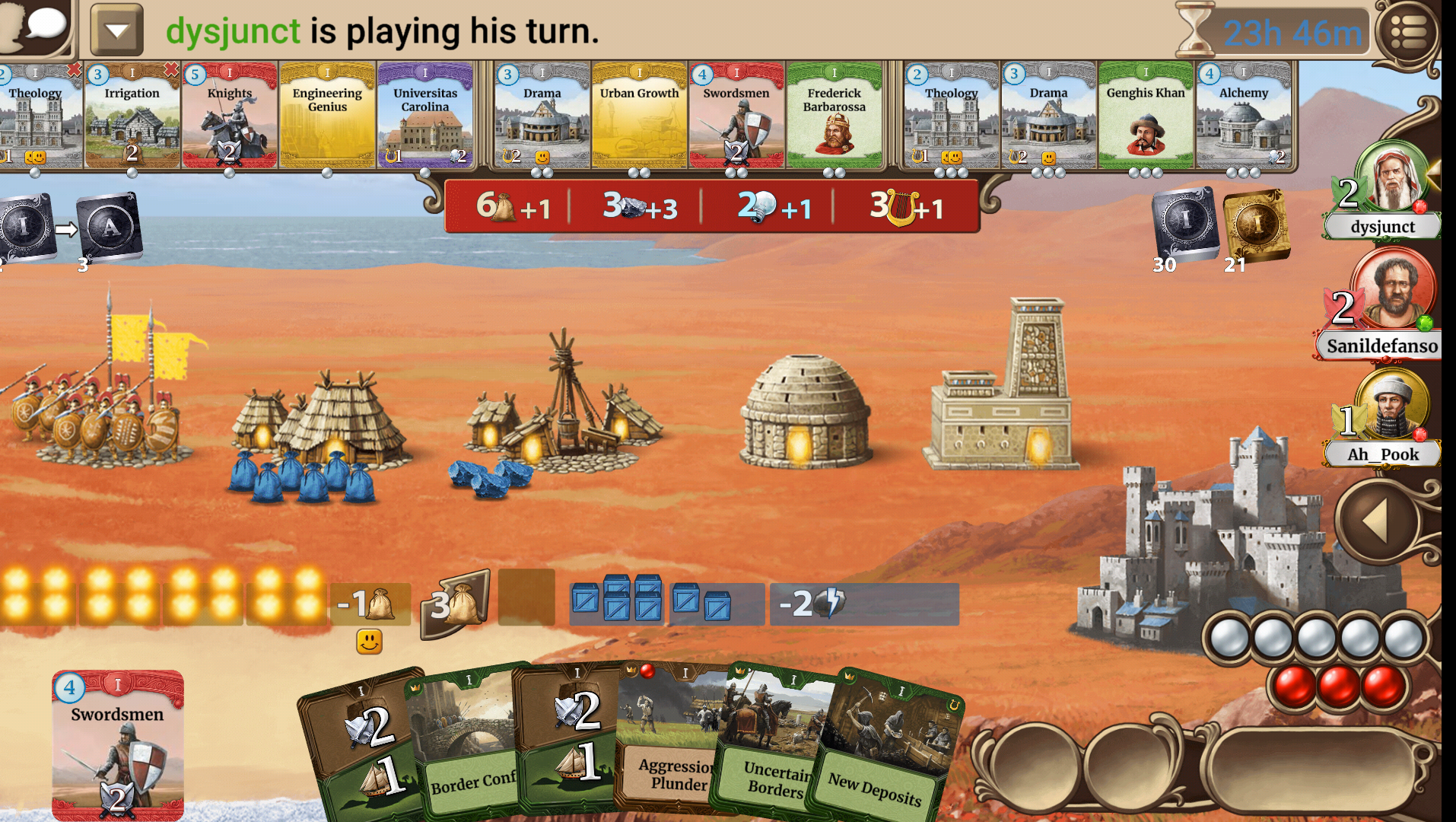
Vlaada Chvatil has, since the original release of Through the Ages, become known for his punishing design philosophy. Games like Galaxy Trucker and Space Alert contain phases that actively try to destroy what the players have accomplished. Through the Ages is, in this regard, a gentler game. Still, this is also quite a complex game, and it will take a while when played face to face. Fortunately there is a terrific app, probably the single best board game app I’ve ever played. It is easy to connect with friends, and it supports asynchronous play well. Most of all, it removes the need to physically move cards and cubes around the table. I do prefer the game face-to-face, but this is not an easy one to get played for my lifestyle, so I appreciate having the app there for me. There’s also an expansion coming out later this year that will add new wonders and leaders. The latter will be especially welcome, since the variety of leaders in the original game is disappointingly Euro-centric. Hopefully the expansion will address that.
It’s easy to over-invest in civilization games. They are at their best when they are lengthy and complex, because such gameplay is appropriate for the full sweep of history. But in that class, I think that Through the Ages is probably the most strategically rewarding game, and it feels more thematically satisfying to me as well. It’s a great example of how Euro design ideas can revitalize and refocus old genres to create something unique and satisfying.
 Games Are For Everyone