
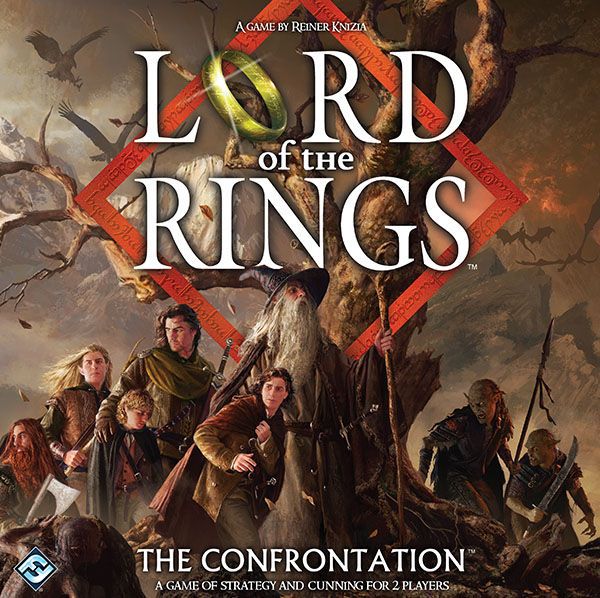
Reiner Knizia is so prolific as a designer that he’s managed to publish several games based on the works of JRR Tolkien. Two of them are terrific adaptations of that classic world, but they take completely different directions. The one that most people remember, simply called Lord of the Rings, was one of the first big hits in the hobby that featured cooperative gameplay. That game cast the players in the role of hobbits journeying through the entire story of the novels, taking the approach of hitting the most popular story beats in a specific order every time. It’s for people who want to live the books, and it’s a great game, one of the most important designs in the hobby around the turn of the millennium. But it’s not the only classic that Knizia has authored in Middle-earth.
Lord of the Rings: The Confrontation is an altogether different experience. Designed for two players, one player takes control of the Fellowship of the Ring, while the other plays the role of the various monsters and villains serving Sauron. The good guys are tasked with taking the Ring to the other side of the board to drop the it in Mount Doom, while the bad guys can win by either destroying Frodo or overrunning the Shire. Taking its cues primarily from the classic game Stratego, the identity of each piece is hidden to your opponent. That means that when your wargs attack, they won’t know if they are facing Pippen or Gandalf, so there’s a huge potential for bluffing and double-guessing. It matters quite a bit too, because each piece has a special power unique to them, making it feel like a game of Chess where you can’t differentiate between your opponent’s pieces.
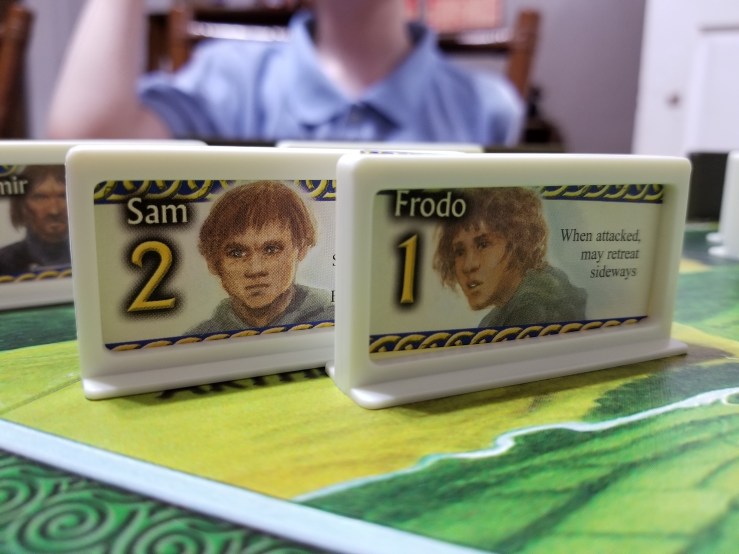
There’s some outstanding design built into these special powers, because they recreate the specific characters in the book so well. If Samwise shares a space with Frodo, he can replace Frodo in battle and become much stronger. Boromir is able to destroy any piece by destroying himself. The Flying Nazgul can attack any single piece on the board, at the cost of revealing the piece’s identity itself. All eighteen pieces feel distinct and well-observed, but they also feel balanced. The result is a game with a ton of thematic flavor, but also an accomplished asymmetric design where each move has a possible counter-move.
If you’ve ever read anything about this game, the character powers are usually celebrated as the big design accomplishment. But they are given more power by the subtlest and best work here, which is the board. The Confrontation uses a square board angled 45 degrees, meaning the players are playing on a diamond shape. The entire geography of the novels is recreated here, with the Shire on one end and Mordor on the other. Each half of the board has six spaces, and there is a spine of four mountain spaces right in the middle. Movement is highly restricted under normal circumstances. Pieces can only move forward, and there can only be two pieces in any given space. In the mountains it’s even more restrictive, since there can only be a single piece on any mountain space. There are also some specific geographical features on the map as well, such as the River Anduin, which the “good” player can use to move horizontally, or the Mines of Moria, which can be used to bypass the mountains completely.
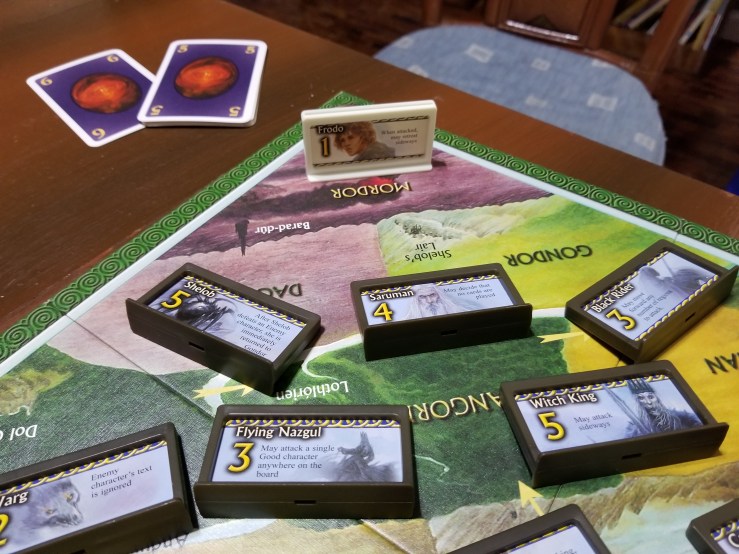
It’s not really an accurate map like the one at the front of your copy of the novel, but it does an outstanding job of forcing the players to make the same kinds of decision points as the characters in the novel. The mountains dictate the whole rhythm of the game. The Good player will need to contend with how to get around them, while the Evil player will need to balance their defensive abilities in the mountains with the need to be proactive and hunt down Frodo. Of course this is all combined with the hidden identity of each piece, meaning that players won’t always be making the obvious move. Or they might be, but will try to make it look like it isn’t so obvious. Bluffing is weird that way.
The potential for bluff and the various decision points give The Confrontation a sense of branching narrative that the cooperative Lord of the Rings avoids entirely. What would happen if Gimli accompanied Frodo all the way to Mount Doom? How about if the Shire was overrun with Orcs and Wargs before Frodo could ever succeed? Combined with a light bit of card combat and a tight 20-30 minute playtime, and you have a surprisingly addictive experience. Most sessions of The Confrontation consist of at least two games, and sometimes more. It’s an intoxicating blend of planning, bluffing, and recreating a beloved story, and it goes down so smooth that it always feels like you could play again.

Lord of the Rings: The Confrontation was originally published by Kosmos in 2002, and like its big cooperative ancestor it featured great artwork by John Howe and got an American release from Fantasy Flight Games. This initial version came in a small square box, making it extremely portable. That’s the version I have and if you find it I would give it my highest recommendation. But there has also been a larger deluxe version that has made it to print a couple of times. This version has a larger board and pieces, and it looks really nice, but the real motivation there is the eighteen alternate characters. If you want to inject some extra variety into the experience, that’s definitely a good option. I can’t vouch for the experience with the alternate characters, since I’ve only ever played my copy. Really, there’s no bad option here, it’s just a matter of what combination you want of portability, variety, and price.
I mention all of those options because I really think Lord of the Rings: The Confrontation is one of those games you will probably like. It’s simple enough to be enjoyed by my nine-year-old son, but also complex enough to present something new every time I play it. Reiner Knizia may always be better known for his cooperative Lord of the Rings game, and that’s an excellent game. But I think The Confrontation is the one I would pick as the more durable design. Its polish and variety, not to mention its well-observed recreations of elements from the novel, make it a no-brainer for people looking for a great two-player experience.
 Games Are For Everyone