
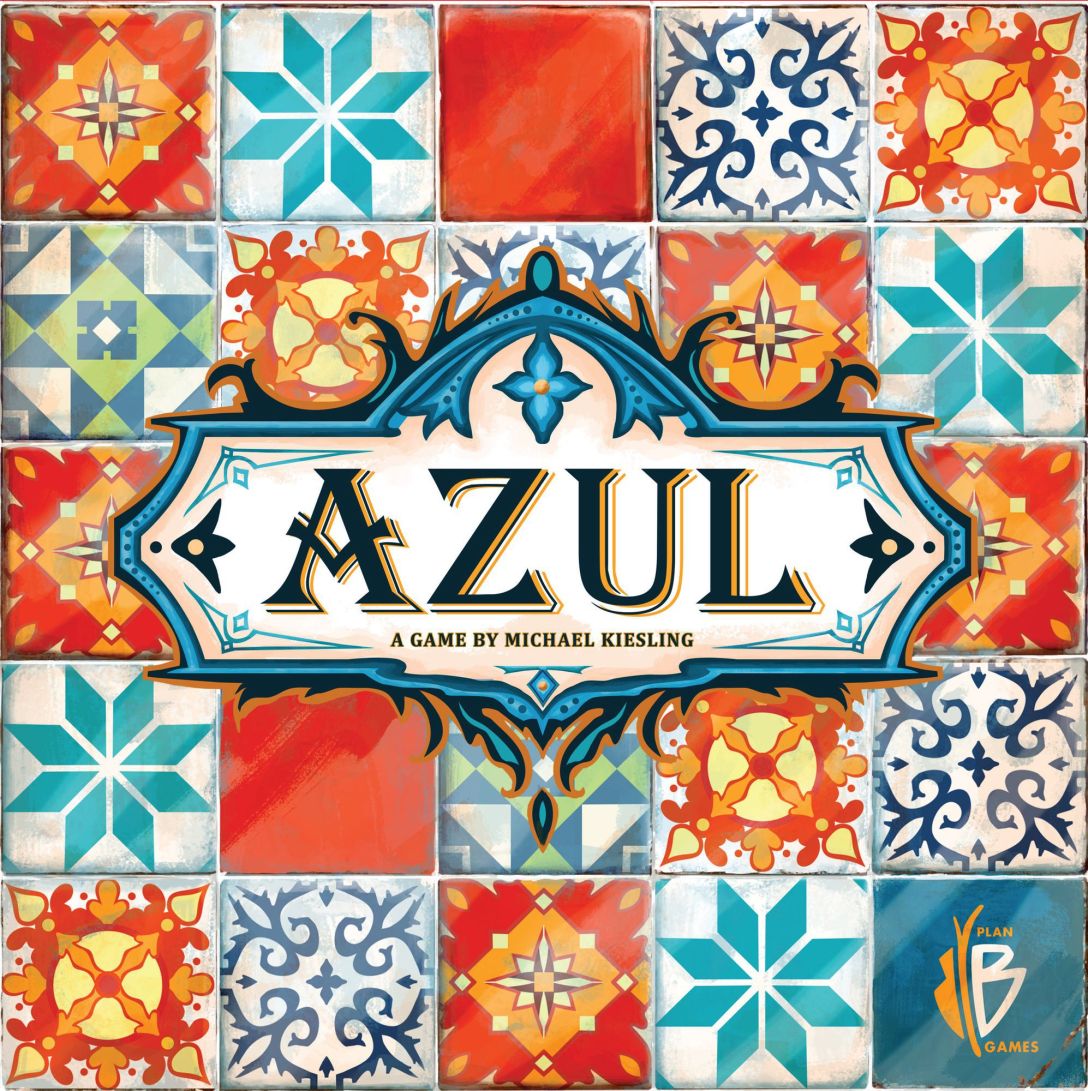
At its very best, German game design understands the power of a single decision point. One of the reasons it came to prominence in the late 90s and early 2000s is because it was able to present players with several choices between two or three compelling options. This is a delicate balancing act, one that is harder than it looks from a design standpoint. It’s possible to not have enough interesting options, presenting the player with what is essentially a false choice, one good option that is too obvious. The other extreme is to give the player too much choice, something that might be interesting for some, but also can be completely paralyzing. I’ve played countless games that have erred in either direction. That’s why it’s such a pleasure when a game like Azul comes along and shows us how to do it right.
I view Azul as something of a culmination. For most of the 2000s, European games trended more and more complex. There were always simpler titles, but they weren’t driving the conversation. But since the advent of crowdfunding I sense a shift has taken place. Complex game design has veered into more thematic territory, leaving the nakedly mechanical European design school to rediscover simplicity. This has manifested in titles like Splendor and the Century series of games. Like many of the games from the 90s, they revolve around one or two main mechanics, end in roughly 30 minutes, and don’t worry much about providing context for their mechanics. (I don’t think it’s a coincidence that such games, notably Splendor, work so well in app form.) Azul is in that tradition, but to me it stands out because it feels like there are two different games going on at the same time. The pleasure comes from watching these two games interact with each other, which they do admirably.
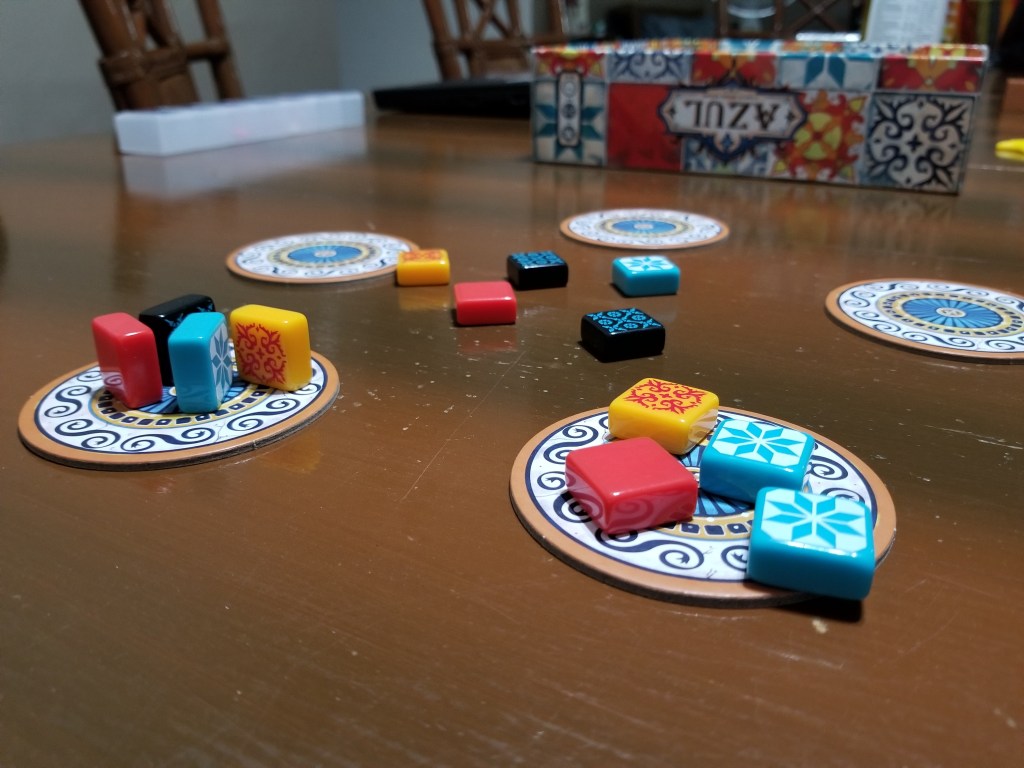
The first “game” in Azul comes in the tile selection, which is basically a draft. Tiles are drawn randomly from a bag, and divided into lots. The players then each have the choice of taking every tile of a specific color in one lot, leaving the rest in the middle, or taking every tile of a specific color from the middle. As is true in a lot of great German game design, this is the kind of choice that has a couple layers to it. The first is what you yourself need. As we’ll examine in a minute, you yourself have tiles that you need in specific number. But the other side is that whatever you leave behind can easily be picked up by other players, perhaps combining with other leftovers to create something truly tempting. There’s also the mechanic of giving the first player to pull from the middle the starting token, along with a slight scoring penalty.
The second “game” is how you arrange those tiles on your board. Each player has a 5×5 grid of the five tile colors in front of them, and each row has, in essence, a staging area where tiles of a single color can wait before going on the grid. Once that “staging area” is filled, one of those tiles is moved onto the grid. There are about three different mechanics intersecting here, the first of which is the different sizes of the “staging areas”. The top row only requires one tile to move over to the right, but the bottom row requires five of them. Then of course there’s the scoring, where each new tile placed on the grid generates points immediately, and at the end of the game depending on their final pattern. Finally, there’s the penalty for not being able to place the tiles you took from the draft. If you get a bunch of tiles and have no place to put them, you can take on water in a hurry.
In isolation, these mechanics are well-executed but not particularly brilliant. You might even be wondering why I just spent over 300 words breaking down some pretty standard mechanics. The pleasure is that all of these elements mesh together flawlessly, making a game that goes down so smooth that it takes a while to see how good it is. But then you start noticing the effects of those mechanics. There’s the way you can stick someone with a pile of tiles they can’t use in the draft, forcing them to take a heavy point penalty on their grid. You might start filling a row to move something to the grid, and then you might not see the tiles you need to actually complete it and move it to your board. There’s the different end-game bonuses that can tilt the draft and the grid play in different directions, allowing the player to pursue strategies that won’t pay off right away. Azul isn’t particularly innovative, but its polish and use of established mechanics makes it something perhaps even better: exemplary.
(To be fair, the way tiles move to the grid is pretty interesting, and I can’t really point to another game that does the same thing. But even if it is unique, it’s not very flashy.)
People tend to respond to good game design, which would explain why Azul has been such a huge hit with my friends. Several people have sought out their own copy after playing mine, and it is not uncommon to set up a second game and immediately play again. It functions well with the full range of players, making it a flexible game that not everyone will love, but that most people will at least like.
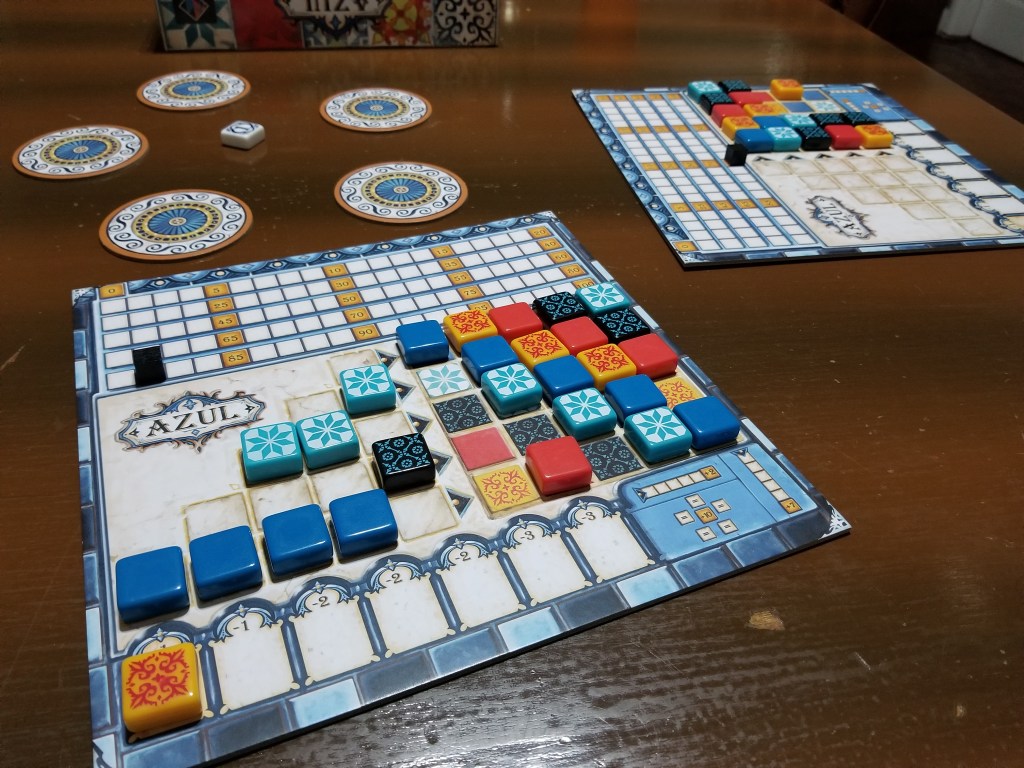
Given the way games like this tend to translate well to smartphone apps, it’s sometimes a fair question to wonder why they aren’t just made as apps in the first place. It’s good then that Azul stands out as a physical product. The game is graphically wonderful. Everything from its blue-red-yellow color scheme to its intuitive design makes this a very pleasant game to play. Best of all are the tiles, which all have a pleasant mass and nice glossy finish. Crucially all of this comes together in a package that is relatively affordable, especially as the cost of games keeps being driven higher by component demands.
On a personal note, Azul has been something of a nostalgic trip for me. This is the sort of game that got me into the hobby, with its reasonable price, nice graphics, and rock-solid gameplay. I eventually moved away from fare like this as I embraced more thematic and more complex games. I still tend that way, but Azul is a good reminder for me of why simple, clean German design is so effective. Designer Michael Kiesling has been active in the German game market for decades now, and his work, particularly with Wolfgang Kramer, speaks for itself. This is an accomplished design. Azul is the sort of game that pulls a few different threads into a polished, attractive whole. It’s the sort of game that I would recommend to people who are entering the hobby for the first time, and it’s a great choice for old hands like myself too.
 Games Are For Everyone